Production logistics in Nepal
Getting around Nepal with a crew
Movement is the cost most Nepal schedules underestimate. The line items that hurt are rarely on the kit list. They are the half day lost behind a stuck truck, the morning flight that did not go, and the extra porters nobody costed because the case count crept up in prep.
Nepal is small on a map and large in practice. The ground rises from the flat Terai plains to the highest mountains on earth across a short north to south distance, and almost every route out of the plains climbs. Crew, cases and freight do not move at the same speed or by the same means, and the further you get from a road, the wider that gap opens.
This page is about the one thing that quietly sets your whole schedule: how a unit and its kit actually move around this country. It covers hill roads and why distance is meaningless, domestic flights and why they cancel, mountain airstrips and their early window, helicopter charter and its limits, porters and pack animals beyond the road head, and how the transport mode you choose sets the number of days you need. Conditions, schedules and rules change, so treat every specific here as something to confirm for your own dates rather than a settled fact.
The numbers that shape movement
General, verifiable facts worth holding in your head before you build a schedule.
Plan in hours, not kilometres
Road distance in Nepal tells you almost nothing. Gradient, surface, single lane sections, roadworks, convoys behind freight trucks and festival traffic all matter more than the number on the map. A leg that looks short can absorb most of a day, and a leg that looks impossible can be quick if the road happens to be clear.
Work in hours, and carry two figures for every leg: a good day and a bad day. Get both from someone who has driven that stretch in that season, not from a mapping app that has never seen a landslide or a checkpoint. Measure from unit base to the location itself rather than city to city, because the last few kilometres are usually unsealed and the slowest part of the journey. A destination can be an easy highway run followed by two hours of rough track that nobody thought to count.
Then add what schedules forget. Loading and lashing kit onto a roof or into a second vehicle. Checkpoints where documents are inspected. Fuel stops. A crew of eight who want lunch. And the rule that you should be off hill roads before dark. Night driving past unlit trucks on a single lane cut into a hillside, with no barrier at the edge and oncoming headlights on the bends, is not worth the hour it saves. Build the day so the driving finishes with daylight to spare, and treat any plan that only works by driving after dark as a plan that does not work.
Nothing here is a guarantee
Roads, flight schedules, airport arrangements and rules change with the season and the year. Everything on this page is general guidance to help you plan. We confirm the realistic position for your specific dates, sectors and locations before you lock anything, and we do not promise weather, flight availability, road conditions or a machine being free on a given morning.
The road network, and what the season does to it
The fastest driving in the country is the east to west highway across the Terai, the belt of flat land along the southern border. Everything that turns north from it climbs and slows. The Kathmandu to Pokhara corridor through Mugling, the routes through Narayanghat, and the roads east into the hills are the main arteries, mostly single carriageway and shared with the heavy freight that supplies the whole country. Improvement works are constant, which helps eventually and hurts on the day, because an upgrade in progress often means one lane, a holding queue, and a wait for the machinery to clear.
Monsoon, broadly June to September, is what breaks schedules. Landslides and washouts close sections with no notice, and because there is often only one road to a place, there is frequently no detour at all. A common outcome is a road open to people on foot but not to vehicles, which means unloading, carrying cases across a slip, and reloading into a vehicle sent from the far side. Whether that transfer is possible, and whether it is safe to attempt on the day, is a judgement for people on the ground and not something to plan on from abroad. Build the schedule so that a closure with no safe crossing costs you a day rather than the shoot.
Winter closes high roads and passes with snow. Dry season brings dust that gets into every case, lens and lung. Strikes and local closures happen too, and they can shut a road as firmly as a landslide. None of this is predictable weeks out, which is exactly why you plan for it rather than against it.
How the season changes each mode
A general picture only. Every specific here shifts year to year and must be confirmed for your dates.
| Season | Hill roads | Domestic flights | Mountain strips | How to plan |
|---|---|---|---|---|
| Autumn, Oct to Nov | Generally at their best after the rains, though slips from monsoon may still be under repair | Busy and in demand, so book early and expect full loads | The clearest flying of the year, but heavily booked | Strong for the mountains, but competition for seats and lodging peaks |
| Winter, Dec to Feb | Lowland roads fine, high roads and passes can close with snow | Morning fog at some airports delays first departures | Cold and often clear, but short daylight and wind close the window early | Good for lower country, cautious for anything high or snowbound |
| Spring, Mar to May | Generally open, dust heavy, some pre-monsoon storms late in the period | Reliable earlier in the window, more afternoon build up later | Good in the mornings, hazier as the season warms | A solid window if you fly and shoot early in the day |
| Monsoon, Jun to Sep | The hardest time, landslides and washouts with no detour | Frequent weather cancellations at both ends | Often closed for days by cloud | Assume disruption, front load the fragile work, hold cover |
Domestic flights buy days, and cost certainty
A domestic flight can turn a two day drive into an hour, and for a far western or far eastern schedule that is often the difference between a viable shoot and an unviable one. Kathmandu, Pokhara, Nepalgunj, Biratnagar, Bhairahawa, Bharatpur and Dhangadhi work as gateways to their regions, and a well chosen flight can save you a punishing drive over ground that would cost the crew two days and arrive them tired.
What you buy in time you give back in certainty. Schedules get retimed and consolidated, aircraft get reassigned to busier routes, and weather at either end stops the operation regardless of how clear it looks where you are standing. Book the earliest departure of the day. A cancellation at first light still leaves you options, whether that is a later flight, a switch to cover, or a decision to drive. An afternoon cancellation usually costs the whole day, because by the time it is called there is nothing useful left to do with the hours.
Baggage is the other trap, and it catches crews who are used to hold allowances on international carriers. Aircraft on domestic routes are small, allowances are modest, and excess is charged by weight and subject to space on the day. Lithium battery handling varies by carrier and can be strict. Put your case list, with weights, in front of the airline before you book, not at check in. And keep crew and critical kit on the same aircraft wherever you can, so a split load does not strand the camera at one end and the operator at the other.
Each mode trades time for certainty
There is no fastest option, only a set of trades. This is what you are actually choosing between.
Hill roads
Maximum control and the lowest cost, but the slowest and the most exposed to closure. You can stop, wait, and choose your own timing, but distance predicts almost nothing and a single slip can shut the only route.
Domestic flights
The big time saver on long sectors, turning days into an hour. In return you accept cancellations, retimings, tight baggage limits and the risk of a whole day lost if the weather closes in at either end.
Mountain airstrips
The only sensible way into some valleys. They fly visually and early, so a first light slot is the window, and a few bad days build a queue that you join at the back.
Helicopter charter
The most flexible and the most expensive. It buys reach and timing but not weather, and its useful payload falls as you climb, so it often shuttles a heavy load in several trips.
Porters and pack animals
The only way beyond the road head. Everything moves at walking pace and the total weight of your package sets crew size, cost and speed. This is crew, not freight, and welfare comes first.
Freight
Kit that travels as cargo books, clears and runs on its own timeline, separately from people. Road freight is cheaper and slower, air cargo is faster and space limited, and neither arrives when the crew does.
Mountain strips fly visually, and they fly early
Most mountain strips operate visually. The pilot needs to see the terrain and the runway, so flying happens when the air is clear and the wind is manageable, which in the mountains means early. Valleys heat through the morning, cloud builds against the ridges, wind gets up, and operations often stop by the middle of the day. A first light slot is not a preference, it is the window, and if you miss it you are usually waiting for tomorrow.
Lukla, Jomsom, Phaplu, Tumlingtar, Simikot, Juphal for Dolpa and Talcha for Rara all sit in this pattern. Lukla in particular needs checking carefully. In recent years, during the busiest seasons, fixed wing services to Lukla have operated out of Manthali in Ramechhap rather than Kathmandu, which adds a road transfer of several hours that usually starts in the small hours before you reach the aircraft at all. Whether that applies to your dates is a question to settle at the time of booking, not an assumption to carry from a previous trip.
Expect passengers and bags to be weighed, and expect kit to be offloaded if the numbers do not work. These are small aircraft on short runways at altitude, and the weight limits are real, not negotiable at the desk. When a strip closes for a few days, everyone who did not fly is still waiting, and you join the back of that queue behind crews and trekkers who were already there. That backlog, not the single cancelled flight, is what turns a mountain sector into a schedule risk.
A mountain flying morning, hour by hour
The shape of a typical fly day into a visual strip. Times are illustrative, not fixed, and the whole thing can slide or stop.
- The night before
Confirm and pack to fly
Reconfirm the sector and the reporting point, repack to the airline’s weight limit, and separate a minimum working kit you keep with the crew so a bumped load does not strand the essentials.
- Pre-dawn
Road transfer if needed
For sectors staged out of an alternative airport, the road move often starts in the small hours. Build that drive into the fly day rather than treating it as a separate leg.
- First light
The window opens
Weighing, boarding and the earliest departures. This is the calmest, clearest air of the day and the best chance the flight goes at all.
- Mid-morning
The window narrows
Cloud starts to build in the valleys and wind picks up. Later slots are more likely to be delayed, consolidated or cancelled outright.
- Around midday
Operations often pause
Many strips stop for the day once conditions deteriorate. If you have not flown by now, plan on the assumption that you are not flying today.
- If it does not go
Switch, do not wait
This is where a named decision maker and a stated cut off time earn their keep. Move to the grounded cover plan or start the drive rather than losing the day to hope.
Helicopter charter, and why payload falls as you climb
Charter buys flexibility. It does not buy weather, and it does not buy lift. As altitude and temperature rise the air thins and useful payload drops. A machine that lifts a substantial load out of the Kathmandu valley may carry only a fraction of that into a high landing zone, and may need to shuttle in several trips, each with its own flight time, its own cost, and its own dependence on the weather holding.
So never ask what a helicopter can carry in general. Ask the operator what it can carry into that specific landing zone, at that time of day, in the conditions expected, with fuel to get back or to reach a refuelling point. Positioning fuel at altitude is a job in itself and costs both time and money, and it has to be planned before the first rotor turns.
Two further points matter. Aerial filming and landing at particular sites can require permissions separate from your general filming approvals, so confirm the current position early rather than discovering a restriction on the day. And helicopters in the mountains are also the rescue asset for the whole region. Nobody can promise you availability on a given morning, because a machine you were counting on may be tasked to an emergency. Take your own medical and insurance advice, and do not design a schedule that only works if a machine is there when you want it.
What to pin down before you charter
A charter conversation goes well when you bring the specifics. The operator can only give you a real answer once they know exactly where you want to go, when, with what, and why. Vague questions get optimistic answers, and optimistic answers are the ones that fail on the mountain. Come with the landing zone, the elevation, the time of day, the total weight of people and kit, and what you actually need to achieve, then let the operator tell you what is possible rather than the other way round.
Above the road head, people carry things
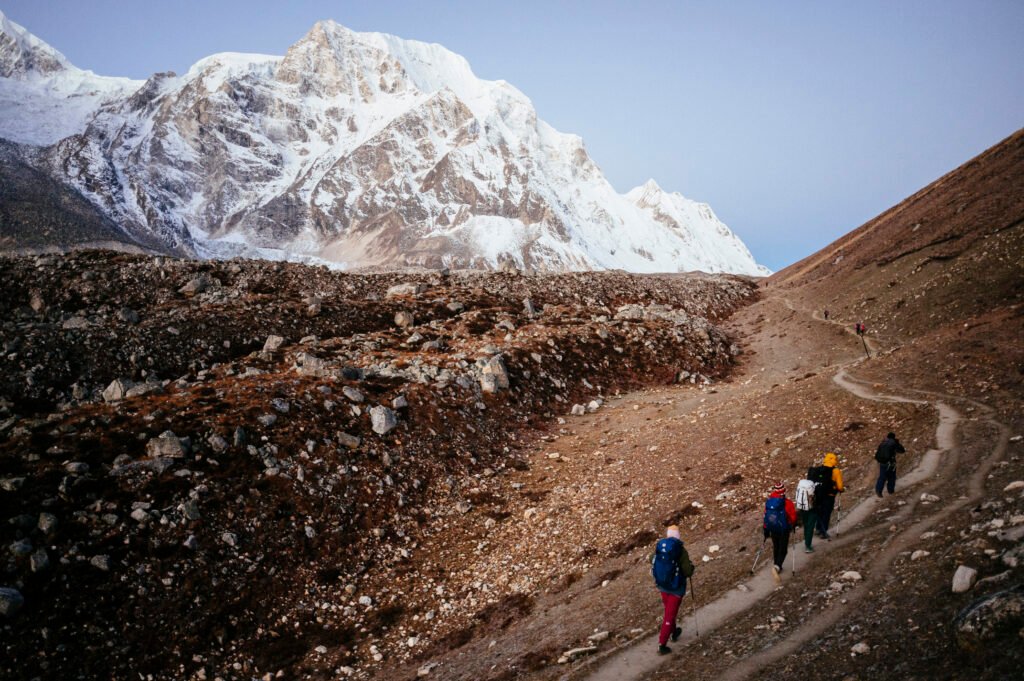
The road head is where vehicles stop and everything changes. Beyond it, kit moves on backs, human or animal, at walking pace on gradients, and the total weight of your package becomes the number that governs crew size, cost and speed. Every case you add is another load, and every load is another person, another rate, another mouth to feed and another body to house. This is the point at which lens and lighting choices stop being creative decisions and become logistics decisions.
Treat porterage as crew, not freight. That means named individuals, an agreed daily rate, food and lodging, insurance, and clothing and footwear suitable for the altitude and season they will actually be working in rather than the altitude at which you hired them. A porter engaged in a warm valley may be carrying your kit over a cold, high pass two days later. Put a maximum load per person in writing and weigh loads at the start of each day instead of estimating them by eye. Porter welfare organisations publish guidance on load limits and conditions, and that guidance exists because the industry has a poor history here. Take the conservative figure, always.
Repack for the medium. Large flight cases do not sit well on a back or a mule, and a case that is fine on a trolley is a hazard on a narrow path. Break kit into carriable, waterproofed loads, and keep media, batteries and fragile optics with the crew rather than in a load that walks separately. Pack animals cannot go everywhere either. Some bridges, steps and narrow sections rule them out, and their daily range is not the same as yours, so a mule train can set the pace of the whole unit.
Porter welfare is not optional
The people who carry your kit into the mountains are the most exposed members of the unit and historically the least protected. Agree a written load limit and weigh to it, provide food, lodging, insurance and season-appropriate clothing and footwear, and never let a case count creep push loads past a safe weight. Follow the conservative guidance published by porter welfare organisations. A shoot that treats porters badly is not one we will run.
Movement terms, plainly
The words that come up when you plan how a unit moves, and what they actually mean on the ground.
Road head
The point where the motorable road ends and everything beyond moves on foot, by porter or by pack animal. It is the single most important line on a mountain schedule.
Visual flying
Operating by sight of the terrain and runway rather than by instruments alone. It is why mountain strips fly in clear, early conditions and stop when cloud or wind arrives.
Payload
The useful weight, people plus kit plus fuel, that an aircraft can actually lift in the real conditions. In the mountains it falls as altitude and temperature rise.
Positioning fuel
Moving fuel to a remote or high point in advance so a helicopter can refuel and continue. It costs time and money and has to be planned before the operation.
Manifest
The master list of every case with its weight and dimensions. Every booking, permit, aircraft and porter calculation comes off this one document.
Porterage
The carrying of loads by people beyond the road head, treated as crew with rates, welfare and written load limits, not as anonymous freight.
Load limit
The maximum weight one porter should carry, agreed in writing and weighed each day. Take the conservative figure that welfare guidance recommends.
Shuttle
Splitting a load a helicopter cannot lift in one go into several trips. Each shuttle has its own flight time, cost and dependence on the weather holding.
Freight moves separately from people
Kit that travels as cargo books separately, clears separately and runs on its own timeline. The most useful document you can build in prep is a manifest with a weight and dimensions for every case, because every booking, permit, aircraft and porter calculation comes off it. A manifest that is current and honest is worth more than any amount of optimism about how the loads will fit.
Domestic air cargo on small aircraft is space limited and gets bumped when passenger loads are heavy, so a case you assumed would fly may sit at the airport waiting for room. Road freight is cheaper, slower and exposed to exactly the same landslides as everything else. Anything large, generators, lighting, grip, is going by road, which means it needs to leave earlier than feels necessary and arrive before you do, not alongside you.
Plan on the assumption that crew and freight will not arrive together. Keep a minimum working kit, the pieces you could shoot something usable with, physically with the crew rather than in the freight run. If the freight runs a day late, and it can, that one decision is the difference between a slow first day and a lost one. It is a cheap piece of insurance and it costs only a little forethought in packing.
How a movement plan comes together
The order that keeps a schedule honest, from the first case count to the client brief.
Build the manifest first
List every case with weight and dimensions and keep it current through prep. Every other decision, flights, porters, vehicles, payload, comes off this list, so it has to exist before anything is booked.
Time every leg twice
Get a good day and a bad day figure for each road leg from someone who has driven it in that season, measured from base to location. Work in hours, and add loading, checkpoints, fuel and food.
Choose the mode per sector
Decide sector by sector whether to fly or drive, based on time saved against the cost of a cancellation. Fly the long sectors where a drive eats days, drive the shorter ones where control matters more than speed.
Book the earliest slots
Take the first departure of the day on every domestic sector, confirm baggage and battery handling for your actual case list, and check where any Lukla service is operating from for your dates.
Set decision points
Name a decision maker and a cut off time for each fly day, agree the trigger to switch to cover or start driving, and hold a grounded cover list that needs no aircraft to shoot.
Brief the client on the shape
Tell the client before departure that a lost day is planned for, where the buffer sits, and what the cover plan is. An anticipated lost day is a plan working, not a crisis.
Distance is meaningless here. What sets your day count is the mode you move by, and every mode trades time for certainty in a different way.
How we workHow the transport mode sets your day count
The number of days a Nepal schedule needs is decided less by how far you travel than by how you choose to travel. A destination reachable by an early flight might cost a single day each way with a cover plan behind it. The same destination by road might cost two days each way plus a contingency day for a closure, which is not a small difference over a fortnight, it is the difference between one shoot and another.
So choose the mode sector by sector, and let each choice carry its own buffer. Assume you will lose a day somewhere. The question is not whether, but whether losing one costs you one or costs you the shoot. Front load the fragile material, putting the flight dependent and weather dependent element early and never on the final day, so there is room behind it to recover. Keep a grounded cover list ready: interviews, detail, city material, anything shootable at or near base without moving. Never schedule travel and shooting on the same day when the travel is a mountain flight or a long hill drive.
Put the buffer in the schedule rather than the budget, and put it before the international flight home rather than after the last shoot day, so a slip does not push into the flights out. Set decision points instead of hoping, with a named person and a stated time, so that ambiguity at eight in the morning in an airport does not turn a delay into a wasted day. Do all of this and the movement plan becomes the quiet, dependable spine of the shoot rather than the thing that keeps failing it.
Settle these before you lock the movement plan
The short list that keeps a schedule standing when a day goes wrong.
- A case manifest with weight and dimensions for every item, kept current through prep
- Two timings for every road leg, good day and bad day, from someone who has driven it that season
- Airline confirmation on baggage allowance, excess and battery handling for your actual case list
- Earliest available departures booked on every domestic sector
- Written confirmation of where any Lukla service is operating from for your dates, if relevant
- Payload from the operator for the specific landing zone, time of day and fuel plan
- Porter terms in writing: rate, load limit, food, lodging, insurance, clothing and footwear
- A grounded cover list of material that can be shot at base with no movement
- A named decision maker and a stated cut off time for switching to the cover plan
- Separate arrival timelines for people and freight, with a minimum working kit travelling with the crew
Questions about moving a unit around Nepal
How long does it take to drive between Kathmandu and the main hill destinations?
Long enough that you should budget most of a day for the well known corridors and confirm the position close to travel. Any single figure quoted online is a good day figure, and good days are not the ones that break schedules. Ask a driver working that route in that month, and carry a bad day figure alongside it, measured from your base to the actual location rather than city to city.
Should we fly or drive?
Flying buys days and costs certainty. Driving costs days and gives you control. A common approach is to fly the long sectors where the drive would eat two days or more, and drive the shorter ones where a cancellation would hurt more than the hours saved. If a sector absolutely must happen on a given day, the road is often the more reliable answer, weather permitting, because it does not depend on cloud clearing at a mountain strip.
What happens if a mountain flight is cancelled?
You wait, and so does everyone else booked on that route, which means a backlog you queue behind. Some destinations have a walking or driving alternative measured in days rather than hours, and some effectively do not. This is why you book first departures, front load mountain material, and hold a cover plan that needs no aircraft. The single cancelled flight is rarely the real cost. The queue that forms behind it is.
Why do domestic flights get cancelled so often?
Weather at either end is the main reason, and small aircraft on visual routes have little tolerance for cloud, wind or poor visibility. Beyond weather, schedules get retimed and consolidated and aircraft get reassigned to busier routes. None of it is a sign anything has gone wrong. It is simply how flying works in this terrain, which is why the earliest departure and a cover plan matter more than the timetable.
Can we hold a helicopter as a backup?
You can charter one, subject to availability, weather and payload, but treat it as an option rather than a guarantee. Nobody can promise a machine will be free and able to fly on a particular morning, and helicopters in the mountains are also rescue assets that can be tasked to an emergency at any time. A schedule that only works if the helicopter flies is a schedule with no plan behind it.
Why does a helicopter carry less at altitude?
As you climb, the air thins, and as temperature rises the air thins further, so the rotor has less to work with and useful payload falls. A machine that lifts a heavy load out of a low valley may carry only a fraction of that into a high landing zone, and may have to shuttle it in several trips. Always ask the operator for a payload figure at your specific landing zone and time of day, never a general one.
How much kit can we take above the road head?
As much as you are willing to pay people to carry, at the pace people walk, which is the real constraint. Every extra case adds a person, and every person adds cost, food, lodging and time. This is where lens and lighting choices stop being creative decisions and become logistics decisions. Cut the package before you leave home, not at the trailhead, and repack into carriable, waterproofed loads that sit well on a back or a mule.
How should we treat porters?
As crew, not freight. That means named individuals, an agreed daily rate, food and lodging, insurance, and clothing and footwear suitable for the altitude and season they will actually be working in. Put a maximum load per person in writing and weigh loads each day rather than estimating them. Follow the conservative guidance that porter welfare organisations publish. The history of this work makes that care a requirement, not a courtesy.
When is the hardest time of year to move a unit around?
Monsoon, broadly June to September, when landslides close roads and cloud closes strips. Deep winter brings snow closures on high roads and passes. The shoulder periods are generally kinder, but they are also when tourist traffic peaks, which affects flight availability and lodging above the road head. There is no season without a trade off, so the plan matters more than the month.
Do crew and freight travel together?
Assume they do not. Kit that travels as cargo books, clears and runs on its own timeline, and large items like generators, lighting and grip usually go by road and need to leave earlier than feels necessary. Keep a minimum working kit with the crew, the pieces you could shoot something usable with, so that if the freight runs a day late you have a slow day rather than a lost one.
Tell us what you are planning
A rough brief is enough to start. You will get a straight answer on whether it works, what it involves, and what we think the risk is.